Send the exact assignment or rubric from your classroom and a custom sample written to it lands in 24 to 48 hours, the first one free. HCS/455 is Phoenix’s Health Care Policy: The Past and the Future course. It centers on how health policy in the United States was built, how it gets changed, and what current proposals would do to an organization. Searches like "hcs/455 week 4 assignment example", "HCS455 sample paper", and "HCS/455 week samples" land on this page.
What HCS/455 is really about
HCS/455 runs the length of American health policy in five weeks, which sounds impossible until you see how the course is cut. It is not a survey of everything; it is a set of turning points, each chosen because it still shapes how an organization gets paid or regulated today. Medicare and Medicaid in 1965, the managed care years, the Balanced Budget Act, HIPAA, the Affordable Care Act, and whatever is moving through Congress and the states this term. Around that sits the process itself: how a proposal becomes law, where the money is appropriated, and how a rule written by an agency can matter more to a facility than the statute behind it.
The five weeks tend to run forward in time. The opening week in many sections covers origins and the structure of the American system, including why coverage arrived through employers and what that produced. Middle weeks usually take up the major expansions and the cost control efforts that followed each one, along with the players who shape policy from outside government. Later weeks commonly turn to what is unresolved now: coverage gaps, spending growth, workforce shortages, and the proposals aimed at each. Some sections close with a position paper or a learning team debate, which rewards a defensible argument rather than a balanced summary of everyone's view.
What HCS/455’s assessments ask for
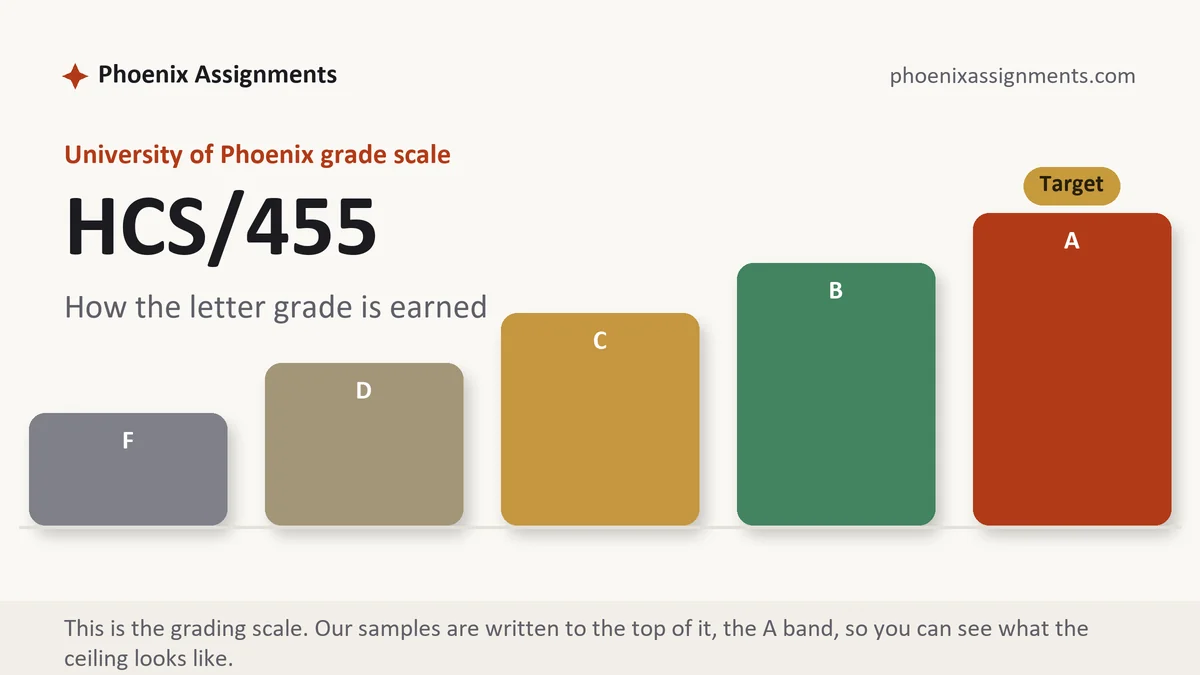
The grading here follows a simple test: does the paper end up somewhere. A description of the Affordable Care Act earns few points; an argument about which provision your organization should be preparing for, and why, earns most of them. Expect to cite legislation and agency material directly, and expect sections to want at least some recent sources, because a paper on current policy built on ten year old commentary dates itself in the first paragraph. Position papers usually require you to name the opposing case and answer it rather than ignore it. Keep the register administrative: what the policy costs, who it covers, what a facility has to change, not what any party says about it.
Where students lose points in HCS/455
The characteristic HCS/455 failure is a paper that reads beautifully and decides nothing. It walks from 1965 to the present, gets the dates right, explains each expansion, and then stops, as though the history were the assignment. It is not. The question underneath every week is what any of it means for an organization operating now, and a paper that never answers it leaves the rubric with nothing to score above a middle band. The repair is one paragraph placed after the history: given all that, here is what my organization faces next year, here is the provision or proposal that drives it, and here is what administration should do about it before it arrives. History earns its place by supporting that claim, not by preceding it.
The HCS/455 drawers
HCS/455 Wk 1 assignment example
Wk 1 often covers origins and why coverage in America arrived through employers. Full sample paper, annotated: Origins of U.S. Health Care Policy.
HCS/455 Wk 2 assignment example
Wk 2 in many sections walks the legislative process and who influences it. Full sample paper, annotated: The Legislative Process and Its Influencers.
HCS/455 Wk 3 assignment example
Wk 3 typically covers the major coverage expansions and the cost control that followed. Full sample paper, annotated: Coverage Expansion and Cost Control.
HCS/455 Wk 4 assignment example
Wk 4 usually moves to today's unresolved problems, from coverage gaps to workforce shortages. Full sample paper, annotated: Current Issues in Health Care Policy.
HCS/455 Wk 5 assignment example
Wk 5 commonly asks for a position paper that argues where policy should go. Full sample paper, annotated: Health Care Policy Position Paper.
Your classroom shows something else?
University of Phoenix revises courses; week counts and deliverables shift between terms. Send what your classroom shows and the desk matches it exactly.
Using a HCS/455 sample the right way
Send the instructions, the rubric, and the policy or proposal you were assigned, and the sample comes back with the history compressed and the implication argued. It costs nothing the first time and arrives inside 24-48h, which is the whole margin you get in a five week block. Where a week asks for a position, the sample takes one and defends it, so you can see how the counterargument gets handled without the paper going soft. Use it as a shape to write against, then swap in the organization you know and the sources your own classroom pointed you toward.
How these samples are written
Every sample in this stack is written the way the custom ones are: the instructions decoded first, a subject-matched writer drafting to the rubric, format checked line by line. Phoenix runs several course models, weekly letter-graded, competency-based, and directed-study, so a custom request is always written to what YOUR classroom shows, never from a stale template.
HCS/455 questions, answered
My paper covers the history well. Why did it still score low?
Almost certainly because it never reached the present. Graders read the last section looking for a claim about what the policy means for an organization now, and a well told timeline that stops at the current year does not supply one. Add the paragraph that names the consequence, and the same research suddenly counts as evidence.
How much of the paper should be history?
Usually a quarter of it or less. Choose the two or three moments that explain why the current arrangement exists, compress them hard, and give the remaining space to the implication you are arguing. A five week course does not leave room for a full chronology, and no rubric here awards points for covering every year.
Is it safe to take a side on a policy the class is split on?
It is usually required. Position assignments ask for a defensible claim, and the grade tracks how well you support and defend it, not which side you landed on. State the strongest version of the opposing view, answer it with evidence, and tie the whole thing back to what an administrator would have to do either way.