Send the exact assignment or rubric from your classroom and a custom sample written to it lands in 24 to 48 hours, the first one free. ACC/290 is Phoenix’s Principles of Accounting I course. It centers on the accounting cycle from transaction to financial statement, and what each entry is actually recording about a business. Searches like "acc/290 week 4 assignment example", "ACC290 sample paper", and "ACC/290 week samples" land on this page.
What ACC/290 is really about
ACC/290 is the first real encounter with accounting in most Phoenix business programs, and it gets five weeks like everything else. That pace is the honest difficulty: debits and credits are a language, and languages are learned by repetition, which a compressed course does not hand out for free. The work splits into two kinds. There are the problems, journal entries, adjusting entries, a trial balance that has to tie, worked in a spreadsheet or the textbook platform. There are also written pieces, short papers and discussions that ask what a number means to an owner, a lender or a manager reading it.
Syllabi differ by section, so treat this as the usual rhythm. Wk 1 typically covers the accounting equation, the four statements and what each one answers. Early weeks then usually drill journalizing and posting, the part that rewards doing extra problems nobody assigned. Middle weeks commonly bring adjusting entries and accrual accounting, which is where most people stall, since the entries stop matching the cash they can see. Later weeks often move to merchandising operations, inventory and internal control, closing with statements prepared from a full cycle. Discussions run every week and usually want the plain-language version: what this account tells someone about the business.
What ACC/290’s assessments ask for
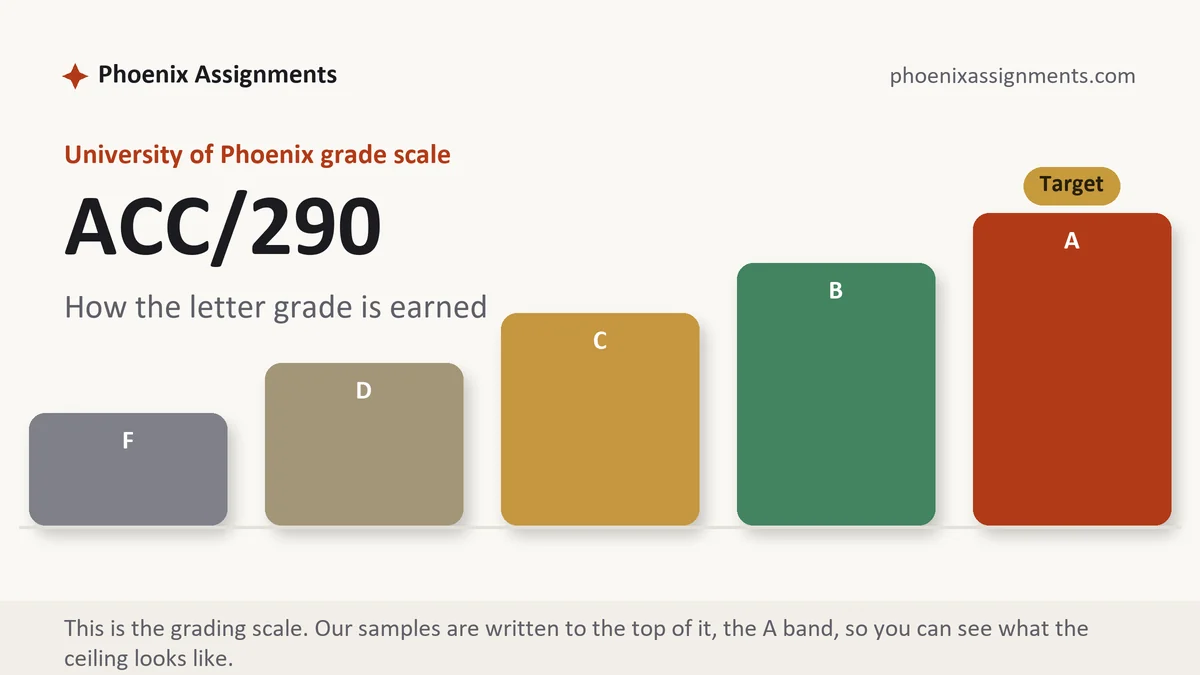
Two standards apply at once in ACC/290, and they are graded differently. Computational work is checked against an answer: the entry is right or it is not, the trial balance ties or it does not, and partial credit usually depends on whether the method is visible. Show the work, label the accounts properly, keep debits on the left and credits indented the way the textbook does, because a grader following your logic can award something even when a number is off. Written work is checked against meaning. When a prompt asks why an adjusting entry is needed, or which statement a lender reads first, it wants a short explanation aimed at a person, with the accounting term used correctly rather than avoided.
Where students lose points in ACC/290
Points go missing in ACC/290 for a reason that surprises people who are good at math: the numbers are correct and nothing is said about them. A submission arrives with clean entries, a balanced trial balance and a tidy income statement, and the written portion is a caption, net income increased this quarter. The prompt asked what that figure tells an owner deciding whether to hire, and the answer never comes. The same gap shows up when a ratio is computed and left bare, or when an adjusting entry is made correctly with no sentence explaining what would have been misstated without it. Accounting is graded as a decision tool here. Finish every calculation with the sentence that says so what.
The ACC/290 drawers
ACC/290 Wk 1 assignment example
Wk 1 often introduces the accounting equation and the four financial statements. Full sample paper, annotated: The Accounting Equation and the Four Financial Statements.
ACC/290 Wk 2 assignment example
Wk 2 typically drills journal entries, posting and a trial balance that has to tie. Full sample paper, annotated: Journal Entries, Posting and the Trial Balance.
ACC/290 Wk 3 assignment example
Wk 3 usually brings adjusting entries and accrual accounting, the week most people repeat. Full sample paper, annotated: Adjusting Entries and Accrual Accounting.
ACC/290 Wk 4 assignment example
Wk 4 commonly covers merchandising operations, inventory methods and internal control. Full sample paper, annotated: Merchandising Operations, Inventory Methods and Internal Control.
ACC/290 Wk 5 assignment example
Wk 5 typically closes with statements built from a completed cycle and a short interpretation. Full sample paper, annotated: Completing the Accounting Cycle: Statements, Closing Entries and Interpretation.
Your classroom shows something else?
University of Phoenix revises courses; week counts and deliverables shift between terms. Send what your classroom shows and the desk matches it exactly.
Using a ACC/290 sample the right way
Use the samples for the written half, since the problems in your section come from your own data set and copying an answer teaches nothing. What transfers is the explanation: how a sample states what the statement shows, names the account, and connects it to a choice someone has to make. Read one, then write your own version from your own figures, and check that every number you present is followed by a claim. If your week runs a problem set or a paper the shelf has not covered, send the instructions and the rubric. The first custom sample is free and arrives in 24-48h.
How these samples are written
The discipline behind every paper here: instructions are the outline, worksheets get filled exactly, decks get outlined slide by slide, and the one-course-at-a-time rhythm means your one course gets the whole desk. Send your week's instructions with a request and the sample matches them, revisions included.
ACC/290 questions, answered
All my entries were right and I still lost points. How?
Almost always on the written portion. Accuracy earns the computation points; the rest of the rubric asks what the result means for someone running the business. Add two or three sentences after each requirement that name the account, say what it shows, and state the decision it informs. The math you already did then counts twice.
How much explanation does a discussion answer need if the question is numerical?
Enough that a reader who cannot see your spreadsheet understands the outcome. Give the figure, then one plain sentence on what it means and one on what it changes. Replies work the same way, so agreeing with a classmate and repeating the total adds nothing, while pointing at a different implication of the same number does.
Do I need to explain an adjusting entry if the entry itself is correct?
Yes, whenever the prompt asks for one, and it usually does. The entry proves you can apply the rule; the explanation proves you know why the rule exists. One sentence on what the statements would have misstated without the adjustment covers it, and that sentence is often the difference between full and partial credit.